AI in Recruitment in 2026: What’s Hype and What Actually Works!
For most of the last two years, the discourse around AI in recruitment has been split into two camps that are equally unhelpful.
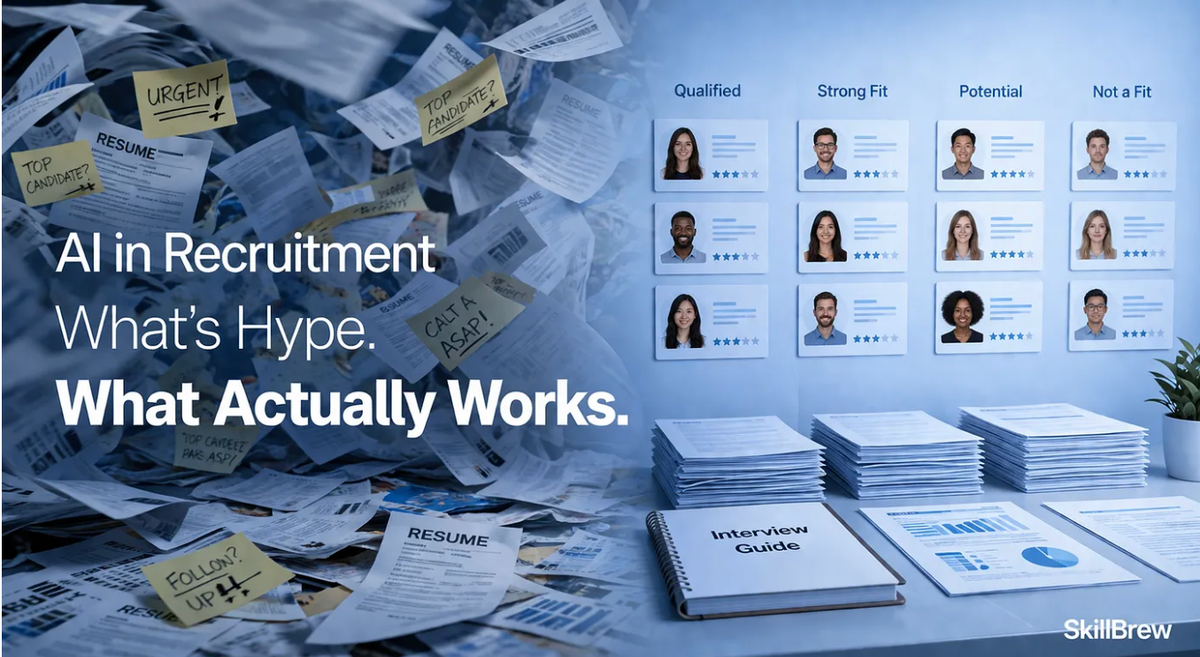
The numbers everyone keeps quoting about AI in recruitment are finally real.
For three years, every HR conference featured the same kind of slide “AI will transform hiring” projected over an audience of leaders who, in private, weren’t using it for much beyond drafting job descriptions. That gap has closed. AI use across HR tasks climbed to 43 percent in 2026, up from 26 percent in 2024. Among Fortune 500 firms, 99 percent now use AI somewhere in the hiring process. The pilot phase is over. The technology is in production.
Which means it’s finally honest-assessment season.
For most of the last two years, the discourse around AI in recruitment has been split into two camps that are equally unhelpful. The hype camp claims AI is replacing recruiters and revolutionizing hiring. The doom camp claims AI is about to destroy fairness, fail every candidate, and trigger a wave of lawsuits. Both are wrong, and what’s interesting is that the data now tells us exactly where each camp is wrong.
Let’s actually look at it.
Where AI is genuinely winning
The strongest evidence sits in volume operations, the parts of recruiting that scale linearly with applicant count, where humans were drowning even before applications spiked.
Resume screening is the clearest win. Staffing agencies report 75 percent faster candidate screening and 30 percent lower cost-per-hire after implementing AI tools. Companies that previously took eight days to produce a shortlist are now doing it in under two. The reason is mechanical recruiter productivity increases by 60 percent when AI handles administrative tasks, and screening is the largest single bucket of administrative time in any pipeline.
Scheduling is the second uncontested win. Around 73 percent of organizations now use chatbots for initial candidate screening, 68 percent for FAQ responses, and 62 percent for interview scheduling. The classic forty-seven-email scheduling chain is essentially a solved problem in 2026, and the time savings compound, every hour a coordinator doesn’t spend on calendar tetris is an hour the team can spend on actual hiring decisions.
Sourcing is the third. AI agents now identify passive candidates from public signals, GitHub commits, conference talks, blog posts, and produce shortlists with reasoning rather than just keyword matches. 52 percent of talent leaders plan to add autonomous AI agents to their teams in 2026, mostly for outbound sourcing. The good ones aren’t replacing recruiters; they’re producing the shortlist a recruiter would have produced in a week, in an afternoon.
Job description generation rounds out the list of clear wins. In 2026, 66 percent of TA teams are actively using generative AI to write job descriptions, according to SHRM’s 2026 State of the Workplace report. JDs are repetitive, high-volume, low-judgment writing, exactly the work LLMs do well.
Anyone telling you these aren’t real wins is reading 2023 takes. The hype here turned into infrastructure.
Where AI is genuinely failing
Now the other side. The places AI is being oversold, and where serious teams are quietly walking back from automation.
Cultural fit and soft skills assessment. This is the hardest wall. AI is good at structured signals, keywords, work history, skill tags, and bad at unstructured ones like adaptability, leadership presence, or how someone navigates ambiguity in a real conversation. The honest framing is that AI can score what’s legible on a resume, but cultural fit lives in the parts of a person that don’t fit on a resume in the first place. Only 31 percent of recruiters let AI make final hire decisions, and 75 percent want humans involved — and that’s not conservatism, that’s calibration based on what AI actually misses.
Bias amplification. This is the most-discussed limitation, and the data is sobering. One study found AI preferred white-sounding names 85 percent of the time. About 19 percent of organizations report AI unintentionally ignoring good candidates. 40 percent of HR leaders cite bias and fairness as their top AI hiring concern. The mechanism is well understood, models trained on past hiring decisions learn the patterns those decisions encoded, including the bad ones. The fix isn’t trivial. It requires diverse training data, ongoing audits, and human review at decision points.