Here’s What 90 Days of Letting AI Run Half My Job Actually Looked Like.
That conversation used to happen in month three of a failed search. Now it happens on day one. The hiring manager thinks I’m smarter. I’m not. I just have the data I didn’t have before.
It’s 9:42 on a Tuesday morning. I’m at a café near my apartment, on my second flat white, about to hop on a call with a senior platform engineer based in Berlin. We’ve been exchanging messages for eleven days. I know his current stack. I know why he’s considering leaving. I know his partner just took a new job that anchors him to his timezone for the next three years. We haven’t talked yet. We’re about to.
Ninety days ago, this scene would have been impossible.
Ninety days ago at 9:42 on a Tuesday morning, I would have been twenty minutes into a sprint through 80 fresh resumes, trying to flag the top 12 before my 10am standup. I would have been half-present to every one of them. I would not have been at a café. I would not have been drinking a flat white. I would have been at my laptop in sweatpants, chewing a cold breakfast bar, clicking through LinkedIn profiles that all started to blur into one vague shape of backend engineer, five years of experience, probably fine.
I’ve been doing this for ten years. Three months ago my head of talent asked me to restructure my workflow around AI tools for a 90-day pilot. I’m going to walk you through what those 90 days actually looked like, because most of what I read online about AI in hiring is either breathless hype from people selling tools or panicked catastrophizing from people who have never run a pipeline. Both miss the point. The point is simpler, and much more boring, and much more important.
AI did not replace my job. It gave me my job back.
Day zero — what a morning used to look like
Let me set the baseline. The contrast is the whole story.
I missed people. I know I missed people. Every recruiter who tells you otherwise is lying.
The afternoon was scheduling. Fifty-eight emails back and forth with candidates trying to find a time that worked. Then an hour of drafting follow-ups to candidates waiting on hiring manager feedback I hadn’t had time to chase down. Then an hour of actually chasing the hiring managers, who always said “I’ll review tonight” and never did. Then a pipeline report nobody read.
Somewhere in that day, in theory, I was supposed to talk to humans.
In practice, I talked to a human maybe forty minutes a day. The rest of the job was logistics dressed up as relationship work.
That was day zero. That’s where the 90 days started.
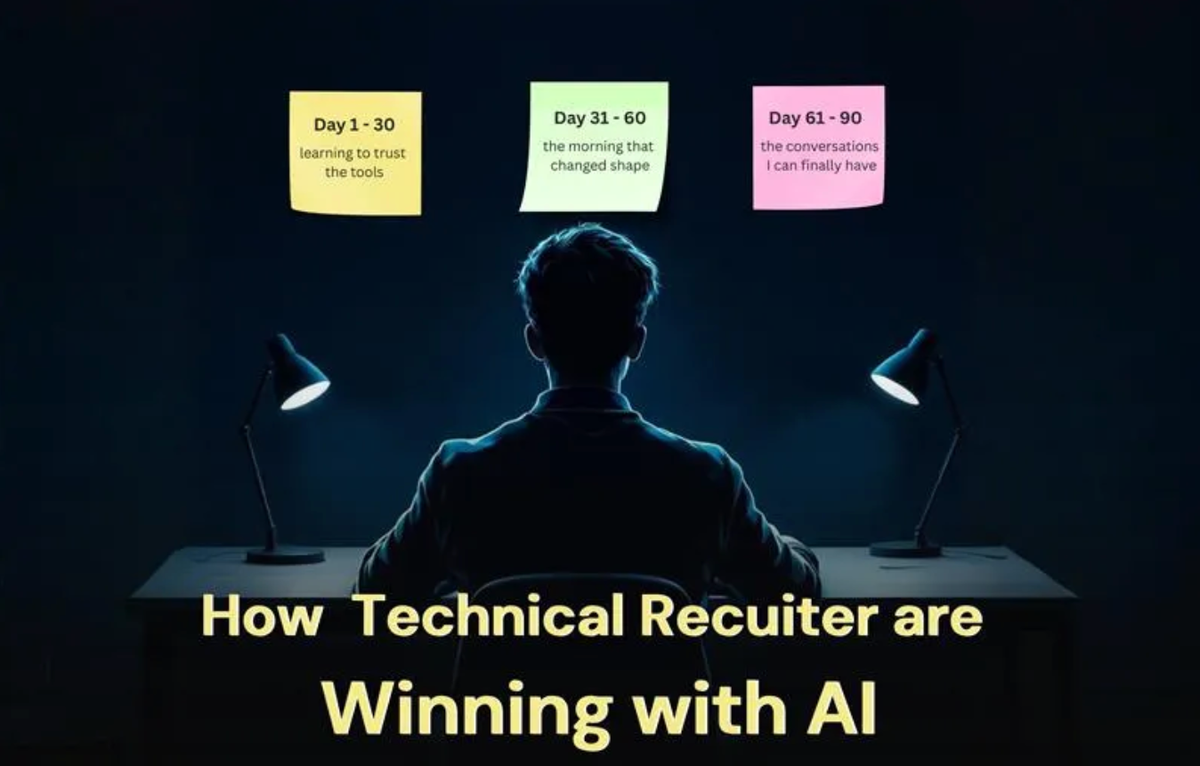
Days 1 to 30 — learning to trust the tools
The first month was uncomfortable.
I didn’t want to let the AI do the first-pass screening. I had ten years of calibrated instinct. I trusted my eyes. So for the first two weeks, I did both — I reviewed every resume the agent had already processed, just to check. What I found was this: we disagreed on about 8% of candidates. On half of those 8%, I was right and the AI had miscategorized someone interesting. On the other half, the AI was right and I had been about to reject someone good out of pattern-matching fatigue.
We were roughly equally fallible. But the AI was fallible in fifteen seconds. I was fallible in ninety.
By week three I’d stopped double-reviewing. I set up a feedback loop instead — every time I disagreed with a screening decision, I logged why, and the agent’s reasoning improved. By day thirty, our disagreement rate was under 3%.
That was the first unlock. Not speed. Calibration.
Days 31 to 60 — the morning that changed shape
Somewhere in the second month, my mornings started looking completely different.
I still wake up at 7:30. But I don’t open 140 resumes.
I open a dashboard where the AI has worked through the overnight applicant pile. It’s done four things. It’s made a first-pass match against the role requirements and given each candidate a short structured paragraph on why they fit — not a score, actual reasoning. It’s flagged the unusual ones. The candidate whose background doesn’t match the JD on paper but whose resume suggests an interesting lateral fit. The candidate whose last company I’ve been trying to recruit from for six months. It’s drafted a personalized first-touch message for each shortlisted candidate that I can edit in thirty seconds. And it’s flagged anyone still waiting on me from previous days.
This takes me about twenty-five minutes of real reviewing. I approve, I tweak, I reject the ones that are obviously off. Shortlist goes to the hiring manager by 8:30.
That used to be my entire morning.
Then I do the thing I couldn’t do before. I go to the café. I take a call with a human.
The candidate I would have missed three months ago