Interesting Facts About Self-Driving Cars You Should Know
Sometimes the sign is faded. Sometimes it’s partly hidden behind a tree. Sometimes it’s covered in dust. Sometimes it’s night and there’s glare from headlights. And sometimes it’s just placed oddly.
The first time I watched a self-driving demo video, my brain did two things at once: this is the future… and nope, I don’t know if I’d trust it yet. Because driving isn’t just rules. It’s messy. It’s people cutting lanes, random speed breakers, half-visible lane lines, and that one biker who appears out of nowhere.
Still, the idea is amazing: a car that can take you from one place to another while you’re not actively driving. Not sleeping (at least not in most cases), but basically letting the vehicle handle the heavy lifting.
So what makes a self-driving car “self-driving”? It mostly comes down to three things working together: sensors, decision-making software, and learning from data.
What is a self-driving car, really?
A self-driving car is a vehicle that can drive with little or no human input in certain situations. It tries to stay in lane, keep a safe distance, follow signals, avoid obstacles, and choose safe paths. The important part is that it’s doing this continuously — not once in a while.
I like to think of it as a loop that never stops:
Notice → Understand → Decide → Move
That loop happens every second, because the road changes every second.
Fact #1: It doesn’t “see” like humans — it measures
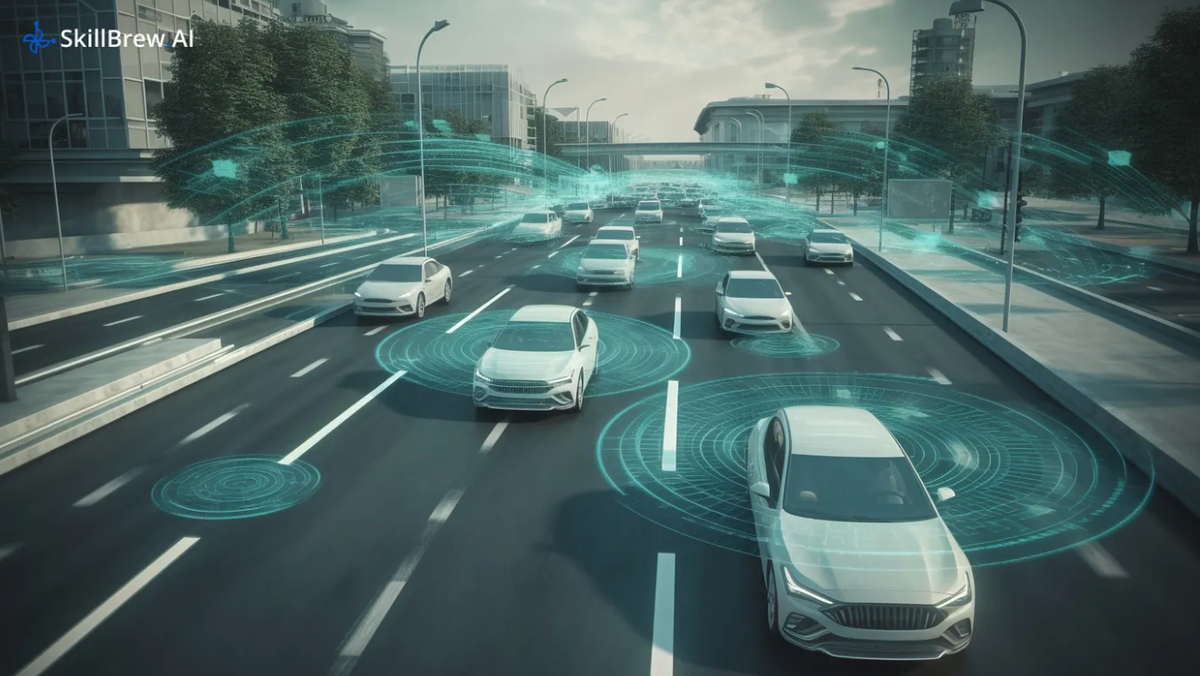
Humans mostly drive with eyes and intuition. Autonomous cars don’t have intuition, so they compensate by using multiple sensors, each good at different things:
- Cameras are great for lane markings, traffic lights, signs, and reading what’s visually present.
- Radar helps estimate distance and speed, and it’s useful when visibility isn’t great.
- Lidar builds a kind of depth map (a 3D sense of what’s around).
- Ultrasonic sensors handle close objects — the stuff you care about while parking.
- GPS and maps help the car understand where it is and what road layout to expect.
Honestly, the “multiple sensors” part is what made it click for me. If one sensor struggles (like a camera in low light), another one still provides useful clues.
Fact #2: Prediction is the real brain-work
People usually think self-driving cars are mainly about detecting objects — “There’s a pedestrian. There’s a car.” But the harder part is predicting what happens next.
Example: you’re driving, and you see someone standing near the road. You instantly judge: Are they waiting to cross? Are they just standing? Are they about to step out?
A self-driving car tries to do the same thing, but with probabilities. It estimates possible movement and chooses the safest plan, usually the cautious plan, because being “confident and wrong” is dangerous.