The Language Barrier That's Quietly Killing Your Hiring Pipeline
Hiring across languages shouldn't mean hiring more people. See how a multilingual AI voice recruiter handles first-round screening at scale without the chaos.
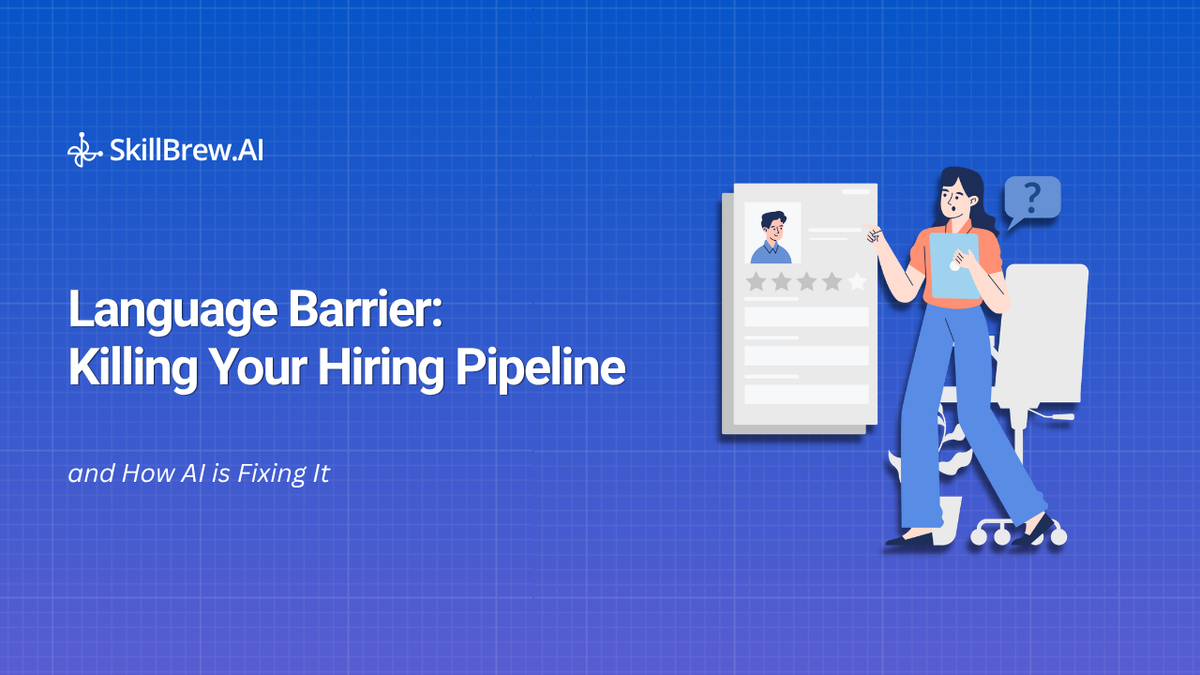
You have 400 applications for 30 open roles.
Your Talent Acquisition (TA) team operates primarily in Hindi and English. Meanwhile, a significant portion of your candidates come from Tamil Nadu, Maharashtra, West Bengal, Telangana, and other regions where candidates are more comfortable communicating in their native language.
The result is familiar.
Screening calls get delayed. Recruiters spend time finding colleagues who speak the candidate's preferred language. Follow-ups take longer. Some candidates lose interest and drop out of the process altogether.
This isn't a recruiter productivity problem.
It's a language infrastructure problem.
As hiring expands into Tier 2 and Tier 3 cities, multilingual screening is becoming a core recruitment capability rather than a nice-to-have feature. Organizations that solve it move faster, reach deeper talent pools, and create a better candidate experience.
This article explores why language has become a hidden bottleneck in recruitment and how multilingual AI voice recruiters are helping Talent Acquisition teams solve it at scale.
Table of Contents
- Why Multilingual Screening Is No Longer Optional
- The Hidden Cost of Language Barriers in Recruitment
- What a Multilingual AI Voice Recruiter Actually Does
- How BrewVoice Handles Multilingual Screening
- The Business Impact of AI-Powered Multilingual Recruiting
- Common Challenges in Regional Language Hiring
- Frequently Asked Questions
- Expand Your Talent Reach with SkillBrew.AI
Why Multilingual Screening Is No Longer Optional
India's workforce has always been diverse.
What has changed is the scale of hiring beyond metro cities.
Campus recruitment, blue-collar hiring, frontline workforce expansion, and regional sales hiring now rely heavily on talent from Tier 2 and Tier 3 cities where English is often not the primary language used for day-to-day communication.
Yet many recruitment processes still assume that every candidate should comfortably navigate an English-language screening conversation.
That assumption creates friction at the very first stage of hiring.
Today's hiring teams need systems that can evaluate candidates effectively regardless of their preferred language.
Because the goal is not to test English fluency.
The goal is to identify capable candidates.
The Hidden Cost of Language Barriers in Recruitment
Language challenges affect more than just communication.
They impact hiring speed, candidate experience, and ultimately hiring quality.
Higher Candidate Drop-Off Rates
Candidates who feel uncomfortable communicating in a non-native language are more likely to delay or avoid screening calls altogether.
Screening Bias
Interviewers may unintentionally associate accent or language fluency with competence, even when the role does not require advanced English communication.
Slower Recruitment Cycles
Recruiters spend additional time coordinating language-specific interviews, finding multilingual interviewers, and rescheduling calls.
Increased Recruiter Workload
Managing language mismatches adds another layer of complexity to already high-volume recruitment operations.
When multiplied across hundreds of candidates, these inefficiencies become a significant operational bottleneck.
What a Multilingual AI Voice Recruiter Actually Does
Many people assume multilingual recruiting technology simply translates questions into different languages.
Modern AI voice recruiting goes much further.
A multilingual AI voice recruiter is designed to:
- Conduct conversations in multiple languages
- Understand regional accents
- Adapt conversational flow naturally
- Evaluate responses consistently
- Generate structured candidate reports
Most importantly, it focuses on what the candidate communicates rather than how closely their speech matches a particular accent or language standard.
This creates a more accurate and equitable screening process.
How BrewVoice Handles Multilingual Screening
BrewVoice, part of the SkillBrew.AI recruitment ecosystem, automates first-round screening conversations across multiple Indian languages.
The process is straightforward.
Step 1: Candidate Applies
Candidates enter the hiring pipeline through:
- Job portals
- Campus drives
- Employee referrals
- Career pages
- Recruitment campaigns
Step 2: Screening Is Triggered Automatically
BrewVoice initiates the first-round screening directly from the SkillBrew.AI dashboard without requiring manual scheduling.
Step 3: Conversation Happens in the Candidate's Preferred Language
Candidates can communicate comfortably in the language they are most confident using.
The AI adapts to:
- Regional accents
- Language preferences
- Conversational pacing
- Context-specific responses
Step 4: Recruiters Receive Structured Insights
Instead of listening to dozens of screening calls, recruiters receive:
- Candidate scores
- Interview summaries
- Conversation transcripts
- Key observations
- Recommendation signals
The result is faster and more consistent screening across large candidate volumes.
The Business Impact of AI-Powered Multilingual Recruiting
The value of multilingual AI screening becomes clear when organizations look at measurable hiring outcomes.
Faster Screening Cycles
Traditional first-round screening often takes several days because recruiters must coordinate schedules and conduct calls manually.
With BrewVoice, screening begins as soon as candidates enter the system.
Many organizations reduce screening timelines from days to hours.
Greater Hiring Capacity
A single recruiter can oversee significantly larger candidate volumes because the AI handles repetitive screening conversations.
This is particularly valuable during:
- Campus hiring campaigns
- Bulk recruitment drives
- Seasonal hiring spikes
- High-volume frontline hiring
Better Candidate Evaluation
Candidates communicate more naturally when speaking in a language they are comfortable with.
This allows recruiters to evaluate:
- Clarity of thought
- Problem-solving ability
- Communication effectiveness
- Confidence
- Role suitability
instead of evaluating English proficiency alone.
Consistent Candidate Experience
Every candidate receives the same structured screening process.
There is no variation based on interviewer style, energy level, or availability.
This consistency creates a more reliable evaluation framework.
Access to Wider Talent Pools
Organizations can recruit effectively across regions without building separate language-specific recruiting teams.
This expands hiring reach while keeping operational costs under control.
Common Challenges in Regional Language Hiring
Even organizations committed to inclusive hiring often encounter recurring challenges.
Limited Multilingual Recruiter Availability
Finding recruiters who can comfortably conduct interviews across multiple regional languages is difficult and expensive.
Accent Variability
India's linguistic diversity creates substantial variation in pronunciation, vocabulary, and communication patterns.
Generic voice systems often struggle with these differences.
Candidate Anxiety
Candidates may perform poorly when forced into a language they rarely use professionally.
This can lead to false negatives during screening.
Scaling Across Multiple States
As hiring expands geographically, maintaining consistent screening standards becomes increasingly difficult.
Multilingual AI recruiters address these challenges by creating a standardized evaluation process that adapts to candidate language preferences rather than forcing candidates to adapt to the process.
Frequently Asked Questions
What languages can a multilingual AI voice recruiter support?
BrewVoice supports Hindi, English, and major Indian regional languages, enabling organizations to screen candidates across diverse linguistic backgrounds.
Can AI evaluate communication skills fairly across different languages?
Yes. Candidates are evaluated on communication effectiveness within their chosen language, including clarity, responsiveness, coherence, and confidence.
Is multilingual AI screening suitable for campus hiring?
Absolutely. Campus hiring often involves candidates from multiple states and language backgrounds. Multilingual AI screening helps maintain consistency while handling large applicant volumes efficiently.
How does AI handle regional accents?
BrewVoice is trained on Indian speech patterns and regional accent variations, allowing it to understand candidates without relying on Western pronunciation models.
Does multilingual screening replace recruiters?
No. It automates the repetitive first-round screening process so recruiters can focus on candidate engagement, final interviews, and hiring decisions.
Expand Your Talent Reach with SkillBrew.AI
Language diversity should be a hiring advantage, not a hiring obstacle.
Organizations that can engage candidates in the language they are most comfortable speaking gain access to wider talent pools, improve candidate experience, and reduce friction throughout the recruitment process.
BrewVoice by SkillBrew.AI helps Talent Acquisition teams achieve exactly that.
By automating multilingual first-round screening conversations, BrewVoice enables faster hiring, greater consistency, and broader talent access without increasing recruiter workload.
If your hiring pipeline is slowing down because of language barriers, it may be time to see what multilingual AI screening looks like in practice.
Book a BrewVoice demo and experience a live multilingual screening workflow on your own hiring pipeline.