
Remote Work vs Office Work — Where Do You Actually Learn More in Tech?
In the tech world, change is always there. It does not matter whether you are learning in a conference room, your home office, a café, or a coworking spot; the essential thing is that you are participating in learning.
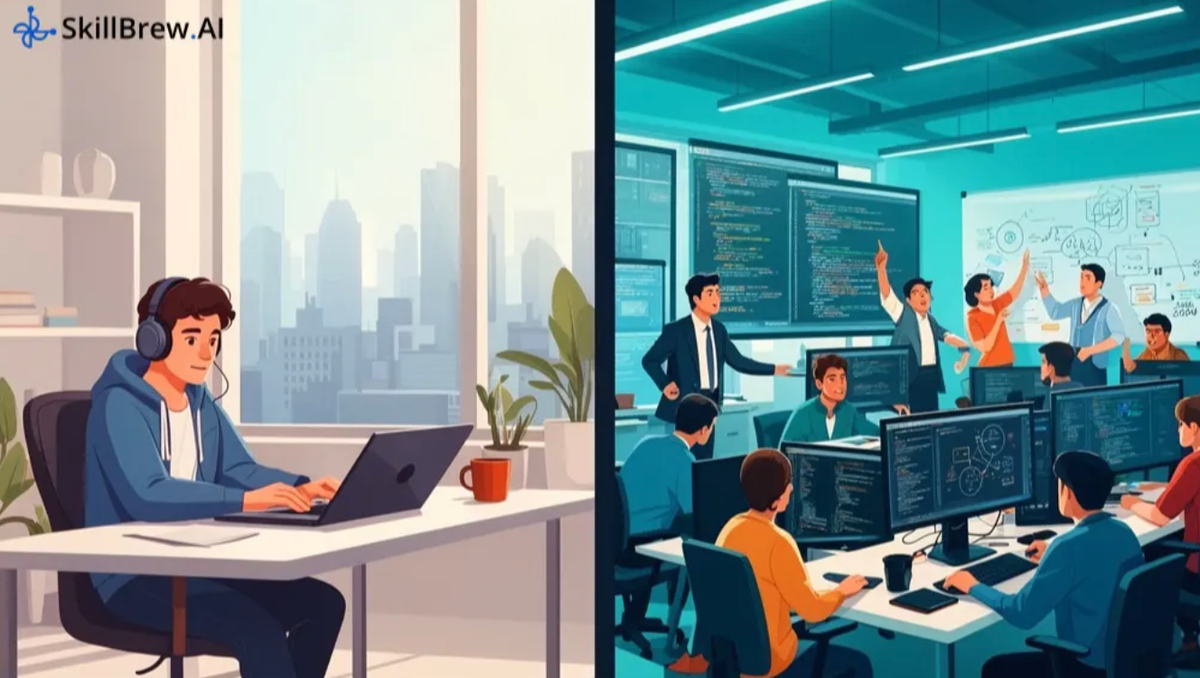
I have been considering the remote versus office work debate in the tech industry quite several times in my mind. My angle was a very pragmatic one and I came up with a most essential question: where does one learn tech, not only at the beginning of the career?
It is an open secret in the field that the tools you are using today are the ones you will have outgrown by next year, and what is regarded as a best practice today might be termed a mistake in eighteen months. Because of such constant changes, it is compulsory to keep learning; otherwise, you fall behind without even realising it.
The remote or office work decision should be seen as a decision that reflects which environment would be more conducive for one’s immersion and speedy learning, rather than being a choice of one’s personality or convenience. During my time both in office and remote phases, I noticed that junior developers achieved rapid growth when they were a part of a local team, and senior engineers became more mentally agile after switching to remote work.
The Office: Learning by Osmosis
There is a powerful thing in being surrounded by people who know more than you in the same place. You hear bits of debates about decisions. You see a person fixing a problem live. You get concepts that you hadn’t thought of before.
This “absorbing knowledge subconsciously” is real — for beginners only.
As a developer, I remember that my tech lead was explaining the reasons for our move from REST to GraphQL when I overheard the conversation. Even though I was not part of that project, hearing that conversation made me understand the concept. Several months later when I was starting to use GraphQL myself, that prior knowledge made it easy for me to understand it quickly.
Mentorship in an office environment is natural and effective. When you have a problem, you just turn around. Ask a short question. Another person might see your screen. Assist you in moving forward in half a minute. There is no inconvenience. No need to schedule a meeting. No fear of disturbing someone.
Definitely, the social pressure also works a bit. When people around you are going through the documentation during the lunch break or talking about the insights they have gained, it motivates you to do the same. In a workplace, the desire to learn is like an infection; it spreads.
But office learning also has a drawback: it can become a passive one. You may feel that you are learning just because you are surrounded by intelligent people, whereas you are not actively participating. If you do not ask questions or investigate things on your own, then all that background talk remains just that — talk.
Remote Work: The Deep Dive Advantage
Remote work is often criticized for making people isolated. This isolation has its advantage: more prolonged focus without interruptions.
When I switched to home office, I suddenly discovered that I had long hours of silence when no one was disturbing me, and I was not dragged into some impromptu meetings. I was finally able to focus on solving the issues instead of constantly jumping from one task to another every fifteen minutes.
Deep concentration is quite often underestimated. To really understand a concept — not just recognise it — you need to be engaged. You need to allocate time for thoroughly going through the documentation, trying out the examples, breaking them, fixing them, and constructing a framework. Remote work gave me that time.
Apart from that, working remotely pushes you to develop one of the most vital skills in the tech industry: self-directed learning. As you cannot just ask the colleague next to you, you become better at understanding error messages, solving problems on your own, and doing research. You start becoming more resourceful.
There is one thing that is hardly ever talked about: working remotely improves your communication skills. Since you cannot point to someone’s screen, you have to explain your problem in the clearest way. Your written messages get better. You describe issues in detail. This skill, by itself, makes your engineering capabilities stronger.
The disadvantage is a lack of discipline. When nobody can see what you are doing, it is quite easy to lose focus. There is no natural momentum around you. You have to create that drive yourself, and not everyone finds it easy.
The Real Question: What Kind of Learner Are You?
The office argument works on the assumption that everybody learns in the same way. Which they do not.
At the beginning of your career, the workplace very often helps you develop faster. When you do not know what you are missing, being engaged in people’s decisions and methods helps you to quickly build your intuition.
However, if you are an effective learner through deep immersive exploration, trial and error, and focused work, then remote work might be even faster in developing your skills, especially if you are comfortable with asking for help when needed.
Some people learn through looking. Others have to wrestle with things on their own first. One is not better than the other — they just suit different environments.
Making Either One Work for You
This is the point: you can learn well in any environment — if you are intentional about it.
In the office:
Do not keep quiet. Ask the reasons for things being done a certain way
Watch skilled engineers as they troubleshoot or review code.
Get involved in talks even if you do not completely understand them.
Pair program whenever possible.
Working remotely:
Develop a learning plan and be committed to it.
Schedule meetings to collaborate on solving issues with colleagues.
Participate in study groups or open source projects for exposure.
Reserve time for focus to thoroughly understand new concepts.
Learning is not passive in either case. It is an active decision.
The Hybrid Middle Ground
Most teams are choosing to work partly from home and partly at the office, and to be honest, that may be the best way, learning wise, of doing things.
Mentorship, whiteboarding, asking questions, and learning from teammates should be done in-office days.
Use remote days for deep dives, project work, reading, and uninterrupted learning.
The mix gives you both the exposure and the focus you need.
What Actually Matters
Ultimately, the speed at which you learn remotely or in an office depends less on location and more on your own self.
I have seen developers getting stuck even in offices full of people because they never got involved themselves. On the other hand, I have seen remote developers perform extraordinarily well because they took control of their development and pushed themselves every day.
The environment matters — However, your enthusiasm, energy, and persistence are still more significant.
Therefore, reflect on this:
Where do you think you can reason better?
In which atmosphere do you feel comfortable if you were to ask questions?
What can you focus on?
At which places do you get more motivated rather than being tired?
Your answers to those questions will have more weight than the opinions of other people about working remotely versus working in the office.
In the tech world, change is always there. It does not matter whether you are learning in a conference room, your home office, a café, or a coworking spot; the essential thing is that you are participating in learning.