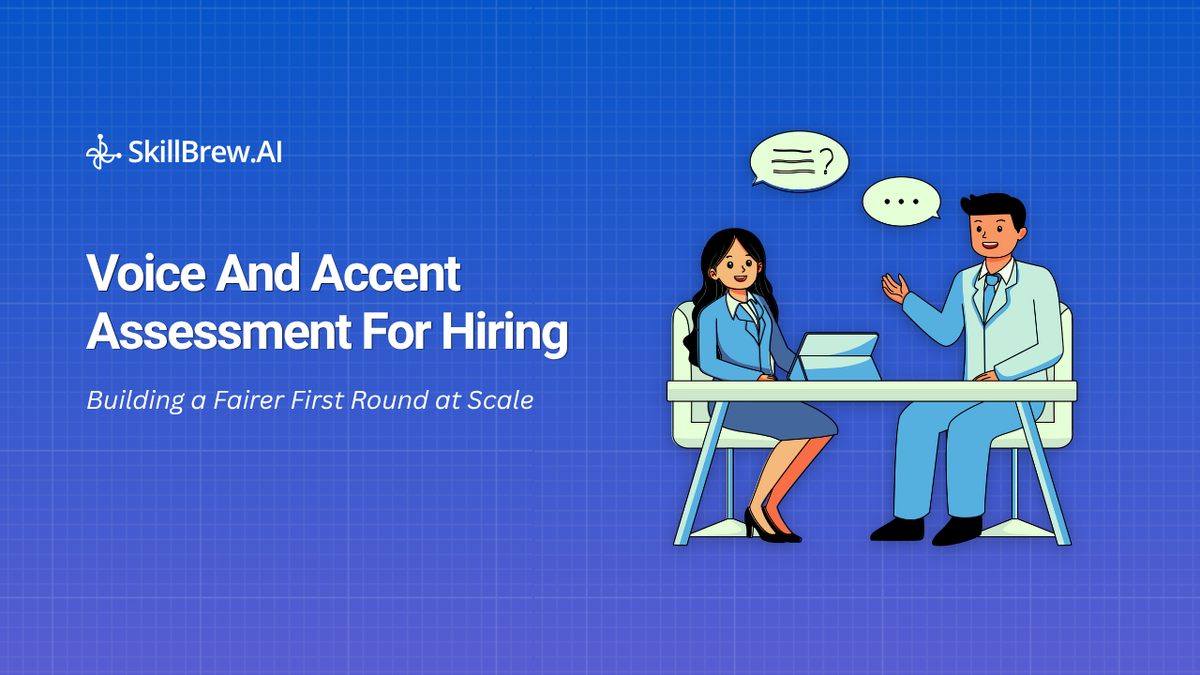
Voice and Accent Assessment for Hiring: Building a Fairer First Round at Scale
Voice and accent assessment for hiring should measure communication, not penalize regional accents. Keep your first round fair at high volume.
Hiring at scale is challenging enough without hidden biases influencing who moves forward. Yet in campus hiring, bulk recruitment, and high-volume screening, candidates are often judged not just on what they say, but on how they sound.
A fresher from Coimbatore or Patna might clear the resume screen and technical assessment, only to lose points during a screening call because their accent feels unfamiliar to the recruiter. The skills are there. The potential is there. But inconsistent communication screening can quietly eliminate strong candidates before they ever reach the interview stage.
This is where voice and accent assessment for hiring becomes valuable. When designed correctly, it doesn't rank accents. Instead, it evaluates communication effectiveness, helping recruiters build a more consistent, scalable, and fair first-round screening process.
Table of Contents
- What Is Voice and Accent Assessment in Hiring?
- Why Accent Bias Quietly Breaks High-Volume Hiring
- What a Modern Voice Assessment Actually Measures
- Traditional Screening vs AI-Powered Voice Assessment
- How BrewVoice Runs a Consistent First Round
- Benefits of Voice and Accent Assessment at Scale
- Best Practices for Fair Communication Screening
- Frequently Asked Questions
- See BrewVoice on Your Own Pipeline
What Is Voice and Accent Assessment in Hiring?
Voice and accent assessment is the structured evaluation of a candidate's spoken communication during the hiring process. The goal is not to determine whether a candidate speaks with a particular accent, but whether they can communicate clearly and effectively for the role.
In many organizations, communication skills are critical for customer-facing, sales, support, operations, and collaborative roles. However, assessing communication manually often introduces inconsistency because different recruiters have different expectations and levels of familiarity with regional accents.
A well-designed voice assessment creates a standardized process where every candidate is evaluated against the same communication criteria.
What a Good Assessment Measures
A modern voice assessment typically evaluates:
- Speech clarity
- Verbal fluency
- Listening comprehension
- Response relevance
- Confidence and professionalism
- Ability to structure thoughts clearly
What It Should Not Measure
A fair assessment should never penalize candidates for:
- Regional accents
- Native-language influence
- Geographic background
- Socioeconomic differences
- Speaking styles unrelated to job performance
The objective is communication effectiveness, not accent preference.
Why Accent Bias Quietly Breaks High-Volume Hiring
India is home to hundreds of linguistic influences and regional accents. A single hiring campaign can include candidates from Tamil Nadu, Bihar, Gujarat, Maharashtra, West Bengal, Assam, and many other regions.
When screening depends entirely on human judgment, bias often enters unintentionally.
Familiarity Bias
Recruiters naturally understand some accents more easily than others. This can lead to stronger scores for candidates whose speech patterns feel familiar, even when communication quality is similar.
Inconsistent Evaluation Standards
Two recruiters may listen to the same response and arrive at completely different conclusions. One might score a candidate highly for clarity, while another focuses on pronunciation differences.
Scale Magnifies the Problem
The larger the hiring campaign, the harder consistency becomes. During campus drives and volume recruitment projects, recruiters may conduct dozens of calls each day. Fatigue and time pressure increase the likelihood of inconsistent decisions.
The result is a hiring funnel that narrows for the wrong reasons, causing organizations to lose qualified talent before meaningful evaluation takes place.
What a Modern Voice Assessment Actually Measures
Done correctly, voice assessment focuses on communication outcomes rather than accents themselves.
A candidate should be evaluated based on their ability to understand questions, process information, and respond effectively.
A structured assessment should answer questions such as:
- Can the candidate understand spoken instructions?
- Can they provide relevant and coherent responses?
- Is their communication clear enough for the role?
- Can they organize thoughts under moderate pressure?
- Do they demonstrate professionalism and confidence?
The "accent" component is not about judging speech patterns. It is about ensuring the assessment system can accurately understand and evaluate candidates from diverse linguistic backgrounds.
This distinction is what separates unbiased communication assessment from traditional accent-based judgments.
Traditional Screening vs AI-Powered Voice Assessment
The difference between manual screening and structured voice assessment becomes especially clear at scale.
| Factor | Traditional Screening Calls | AI-Powered Voice Assessment |
| Evaluation Consistency | Varies by recruiter | Standardized |
| Accent Familiarity Bias | Higher | Reduced |
| Candidate Volume Capacity | Limited | High |
| Screening Speed | Slow | Automated |
| Reporting Quality | Subjective notes | Structured insights |
| Auditability | Difficult | Transparent and trackable |
A standardized process ensures that every candidate receives the same opportunity to demonstrate communication skills, regardless of who evaluates them.
How BrewVoice Runs a Consistent First Round
BrewVoice is SkillBrew.AI's AI voice calling agent designed to automate and standardize first-round candidate screening.
The moment a candidate enters your hiring pipeline, BrewVoice can initiate a structured screening conversation without requiring recruiter intervention.
Automated Candidate Interviews
Instead of scheduling calls manually, recruiters can automatically engage inbound candidates directly from the dashboard.
Accent-Aware Evaluation
BrewVoice is designed to understand diverse Indian accents and speech patterns. Candidates are evaluated on communication effectiveness rather than accent familiarity.
Standardized Scoring Framework
Every candidate is assessed against the same rubric, ensuring consistency across locations, hiring campaigns, and recruiter teams.
Structured Candidate Insights
Rather than reviewing pages of call notes, recruiters receive organized summaries covering:
- Language proficiency
- Communication effectiveness
- Soft-skill indicators
- Confidence signals
- Culture-fit observations
This creates a more objective first-round screening process while reducing recruiter workload.
Benefits of Voice and Accent Assessment at Scale
Organizations implementing structured voice screening often see improvements across multiple areas of the hiring process.
Faster Hiring Cycles
Campus drives and volume recruitment campaigns can move significantly faster when first-round interviews are automated.
Better Regional Talent Coverage
Qualified candidates are less likely to be filtered out because of unfamiliar accents or inconsistent recruiter evaluations.
More Transparent Hiring Decisions
Structured scoring makes screening decisions easier to review, explain, and improve over time.
Reduced Recruiter Burnout
Recruiters spend less time conducting repetitive introductory calls and more time evaluating shortlisted candidates.
Improved Candidate Experience
Every candidate receives the same interview experience, creating a more equitable and professional hiring process.
Best Practices for Fair Communication Screening
To build a truly inclusive communication assessment process, organizations should follow a few key principles.
Evaluate Clarity, Not Accent
Focus on whether communication is understandable and effective rather than whether it sounds familiar.
Use Standardized Interview Questions
Every candidate should receive the same core questions and evaluation criteria.
Assess Role-Relevant Communication Skills
Different roles require different levels of communication proficiency. Assess candidates according to actual job requirements.
Combine Multiple Signals
Voice assessment should complement resumes, skills assessments, interviews, and other hiring inputs.
Maintain Human Oversight
AI can improve consistency, but final hiring decisions should remain with recruiters and hiring managers.
Frequently Asked Questions
What is voice and accent assessment for hiring?
It is the structured evaluation of spoken communication skills, including clarity, fluency, comprehension, and confidence. A well-designed system evaluates communication effectiveness rather than accent preference.
Does accent assessment discriminate against regional candidates?
It should not. Modern AI voice assessment systems are designed to understand diverse accents and evaluate candidates using consistent communication criteria.
Can AI voice screening support campus hiring at scale?
Yes. AI voice agents can conduct thousands of first-round screening conversations while maintaining the same evaluation standards across every candidate.
Does AI voice assessment replace recruiters?
No. It automates repetitive first-round screening so recruiters can focus on interviews, decision-making, and candidate engagement.
Which roles benefit most from voice assessments?
Customer support, sales, business development, operations, campus hiring, and other communication-intensive roles often benefit the most.
See BrewVoice on Your Own Pipeline
Hiring teams shouldn't have to choose between speed and fairness.
If your organization is struggling with inconsistent communication screening, recruiter bandwidth constraints, or large volumes of first-round interviews, a structured voice assessment process can help create a more objective and scalable hiring funnel.
BrewVoice combines automated candidate engagement, accent-aware communication assessment, and standardized evaluation frameworks to help teams identify strong talent faster while reducing bias in early-stage screening.
Book a BrewVoice walkthrough with SkillBrew.ai and see how AI-powered voice and accent assessment can transform your first-round hiring process.